
As we left Octopus Islands Marine Park, excitement buzzed in the air. Just one more hop and we’d be in waters farther north than I’ve ever been in my own boat.
July 9-10


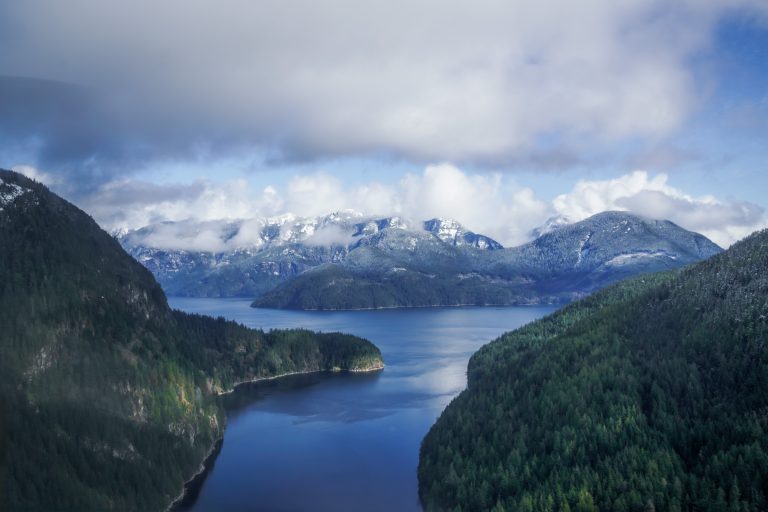
Opting for the scenic route, we took some back channels on our way to Blind Channel, a spot we spent a lot of time at last year. This route offered spectacular views—long inlets framed by dramatic mountains plunging into deep ocean waters. We’re a slow boat, enjoying the meandering paths as much as the destinations.

We saw our first dolphins of the season! My heart leapt—at last, my friends!


Seeing dolphins always grounds me. Among sea life, I feel at home.

But the next day, I saw something that shattered that sense of peace—something I’ve never encountered in all my years on the water. And no one I know has either.
As we left Blind Channel, transiting through Green Point Rapids, I spotted a humpback whale’s blow. I readied my camera, excited for the usual show of blows and arched backs. Another blow, then another, and the huge back rose, signaling a deep dive. The tail would soon appear, so I aimed for the perfect shot. But when the tail emerged… it wasn’t there.
The whale’s tail had been completely severed.
Where a glorious fluke should have been, there was only an ugly, gaping wound. It felt like a punch to the gut.
I won’t be sharing those photos. Words are enough.
I sent the images to the Department of Fisheries and Oceans and several whale conservation groups, including Straitwatch. Ray recorded a video, and soon, our documentation spread across news outlets in Canada and the USA. We granted permission for the DFO and conservation groups to use our materials however they saw fit.
Even now, as I write this, my heart aches thinking about what that whale endured. Experts believe it was caused by entanglement in fishing gear. I can’t shake the image of the poor creature struggling as nets or lines cut into its massive tail, eventually severing it. How it survived that horror is beyond me.
The whale had been sighted a week earlier, further north, and a week after, in Washington State. He was hanging on… but there’s no way he could survive. It’s the saddest thing I’ve ever witnessed.
Since we were moving into waters I’d never been before, I only managed a few shots before continuing on. The whale was heading in the opposite direction, but his plight hasn’t left my mind.
This experience has sparked a new direction for me, a project I hope will make a difference. I’m not ready to share the details just yet, but it’s on the horizon.
We eventually made it to Forward Harbour, but it took five attempts to set the anchor. Maybe I was still off after seeing the whale, or maybe it was just a tricky spot. Regardless, we had to make it work, as a storm was on its way and going any further wasn’t an option.

Once we were settled, we watched the usual anchoring antics unfold around us as more boats tried (and sometimes failed) to secure a spot. In a bay meant for eight to ten boats, there were 22 of us one night, all hiding from the storm. Ray stayed up until 3 a.m., keeping watch to ensure neither we nor anyone else dragged anchor.
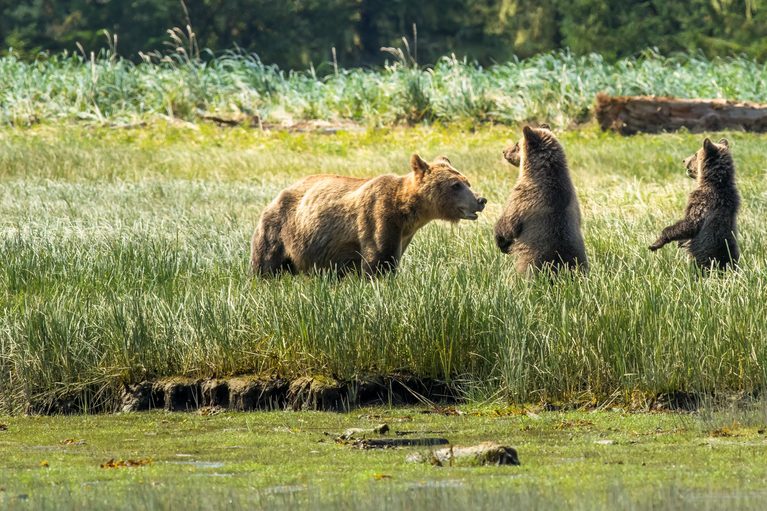
We stayed nearly a week, waiting for good weather to tackle the northern Johnstone Strait and head into the Broughtons. During that time, we were treated to a visit from a big black bear on the beach behind our boat. The first black bear of the season! He strolled along, flipping boulders, looking for crabs—a stunning sight.


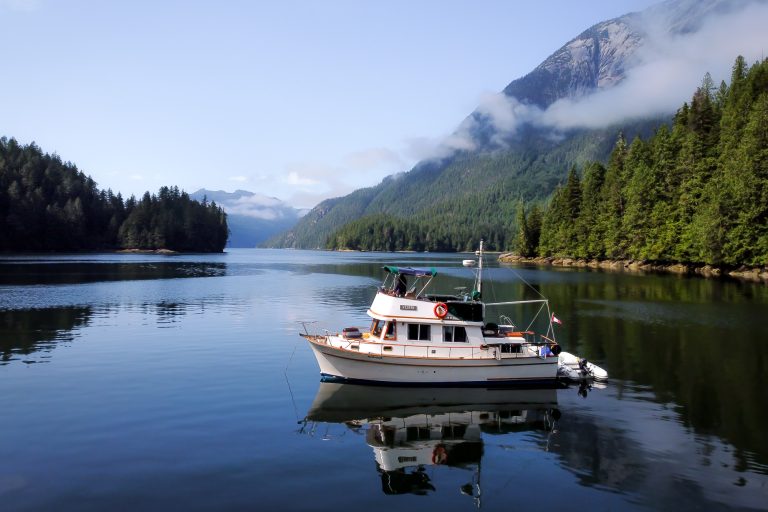
Finally, at first light, we made our exit, rewarded with beautiful rays of sunlight cutting through the clouds.

It’s the same mountain view as earlier, but what a difference light makes!
Next stop: Port Harvey
“chase after nature’s fleeting wonders instead of chasing deadlines” well said Anne. We had 12 days on Vancouver Island late August early September, our second visit to this wonderful paradise. Always enjoy your posts and superb photos. Safe travels.
Thank you so much Peter, and I’m glad to hear you enjoyed our paradise as much as I do. I appreciate your visit and comments.
I am always so happy to see your emails! Wonderful adventures and all its highs and lows. thank you.
So glad you are enjoying them Sonja, thank you!
I wish you fair winds and good seas forever, Anne.
Many thanks Mauricio, I appreciate it!
Hi Anne, Your water travels sound like a wonderful opportunity to see new places from a different aspect than experienced by us land-lubbers! That bear didn’t worry about you because you were not in its territory. No trespassing, no arguments…
Your description of the Humpback Whale without its tail fluke is extraordinary. It hurts to think about it and what the whale endured. Was the wound healed? One good thing about salt water is it has healing properties. Even a large wound can heal if it is kept clean and inflammation is reduced [by osmosis with salt water]., It also contains other minerals that can promote healing. If the whale is swimming and eating, it may be more difficult to move freely, but just like any creature losing a body part, it can usually adapt. Having been seen in multiple locations is proof of that. Hopefully it doesn’t run into any new threats and can live out its life.
Boats and fishing nets are definitely threats to sea life. . It would be great if boat builders would devise a way to protect sea life from the mechanical parts that propel boats through the water.. Nets are made to hold a lot of fish of all sizes, and need to be strong. I don’t know how it could be done, but someone might be able some day to figure out a way to let the net come apart when a certain amount of force is applied. That would facilitate escape by a trapped sea creature, but under normal conditions would still capture and harvest the intended species. And hopefully such a solution would also include a way to put the net back together again with the same properties as before.
Thank you for sharing. Nature is both beautiful and cruel, the need to survive is a basic instinct we all share. I love seeing the places and events you witness with your camera, especially because we don’t travel as much now as we used to. I will be interested to hear about the idea you have simmering when it is ready to share.
Susan from Vermont
Hi Susan, thank you so much for your comment. You are right, viewing bears from the water does seem like a safer way to go. Although they do swim! I had a grizzly swim right past the boat I was in one time, but he had been near us for awhile and was not acting at all threatened or nervous about us, so it was an awesome experience.
Yes, the whale’s wound was healed over. It looked pretty good actually. And he did swim quite a long way. However, there is no way he would be able to migrate. And there are transient orca in these waters. It is only a matter of time. I don’t think there is any way he could survive. It’s so sad.
There are actually fishing nets designed to allow larger creatures to escape. Not whales though, but sea turtles. They use them in places like Mexico and countries to the south. I hope they can find a way to make this technology work for the whales. I was doing a little research and discovered that they are developing ways for crab fishermen to fish without lines as well. They have a sort of remote control that inflates a balloon making the trap rise to the surface. So I hope one day our waters will no longer be like running a gauntlet for whales.
I’m so glad you are enjoying the posts Susan, thanks for taking the time to comment.
Your images are exquisite. The last one is award winning… Thank you for all the images thru out this years jouney… Looking forward to seeing more on your RV adventures… Keep your shutter count high! .
Hi Herb, thank you very much for your kind words and glad you enjoyed that last image. I really like the drama in those kinds of shots.
I still have a long way to go in the boating journey, and stuff from last year’s RV travels to do. I can never keep up! The shutter count just keeps getting higher 🙂
How do ÿou maintain your camera and lenses in that salty environment?
Hi Scott, My wildlife gear I actually leave outside so it is always handy, so I keep it in a pelican case where it is safe from the rain. But I actually got that pelican case years ago when the reason was to keep my camera safe from being bounced around on my small boat! Now it doesn’t get bounced around to the same degree. As far as salt goes, I don’t do anything. It’s not like the gear actually gets splashed and if it did I would just use a wet towel to clean it. The salt air doesn’t seem to affect the cameras at all.